Brody
Requiem for a DreamBrody is the heroin supplier on whom Harry Goldfarb and Tyrone C. Love rely when they try to turn their drug use into a profitable business. His unusually potent supply briefly seems to make that plan possible; its disappearance, followed by his death, leaves them without the connection they had trusted and unprepared to find another.
Identity and Place in the Deal
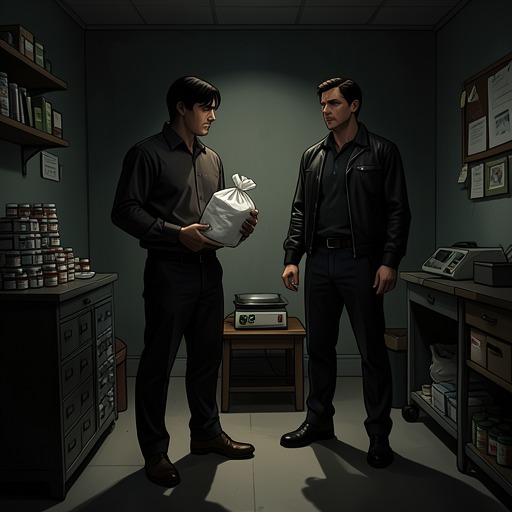
Brody enters the plot as a contact Harry Goldfarb and Tyrone C. Love call after collecting their wages and deciding they have enough money to buy a piece of heroin. His price is about five hundred dollars, possibly as low as four hundred and fifty, so the two men need to find another hundred. They ask Marion Silver for the money, telling her they expect to repay her that night and eventually pursue their plan for a coffee house. Brody is therefore not merely a source of drugs: access to his product becomes the immediate condition for the business venture they imagine building.
When Tyrone returns with a package from Brody, the supplier has refused to let anyone sample it at his place. He has advised them to cut it at least three times and, if they use any themselves, to take only a pinch. Harry and Tyrone debate how they can judge the product without testing it, then decide to try a small amount. Its force confirms Brody’s claim that it is exceptionally strong, and they begin carefully mixing it with milk sugar. Their first impression is that it can be diluted substantially and still sold as a potent product.
Supply and Changing Quality
Brody’s connection initially gives Harry and Tyrone what they regard as a rare commercial opportunity. They believe they can sell the strong heroin, make money quickly, and obtain more. Their confidence is sharpened by the contrast between Brody’s product and the weaker supply they encounter later. Brody’s value to them lies not only in having heroin available but in providing the quality on which their calculations depend.
When Tyrone next asks about the changed product, Brody says he does not know exactly what happened. He passes on an account that the strong heroin may have been connected to men found in garbage cans, with their throats cut and signs left beside them; another part of the explanation is that the men had taken drugs from local suppliers and tried to sell them quickly. The account is hearsay, not a settled explanation. The new supply is much weaker: Harry and Tyrone find that it cannot be cut nearly as much as the earlier product. Brody’s role in this episode is as a source of partial information as well as a dealer, and neither he nor the two men can restore the quality they had relied on.
Death and Consequences
Brody is later found dead in an alley. Tyrone hears several incompatible explanations: Brody may have been shot, stabbed, pushed from a roof, or killed in what others call misadventure. The uncertainty remains unresolved, but his empty pockets persuade Tyrone that he was robbed. Because Brody had either been carrying drugs or had money to buy them whenever he left his place, the theft suggests that whoever killed him understood the value of what he carried.
The loss exposes how completely Harry and Tyrone had depended on a single connection. They had made only a half-hearted effort to find another supplier while Brody’s product was available, believing that he would locate any good heroin in the city and that the strong supply would return. Now he is dead, his earlier product is gone, and they have no dependable backup. Their frustration gives way to the practical recognition that they must search for another source, but Brody’s death has already turned a profitable-seeming opportunity into a crisis.
Narrative Role
Brody’s brief presence links the men’s ambitions to the unstable street economy that sustains them. The package he supplies appears to validate their plan: its potency allows them to imagine cutting it repeatedly while still selling an effective product. But the quality changes, the explanations remain rumor, and the supplier himself is killed under circumstances no one can establish. The plot thus makes their business depend on a commodity they cannot control and a connection they neglected to replace; Brody’s death converts that dependency into immediate insecurity.